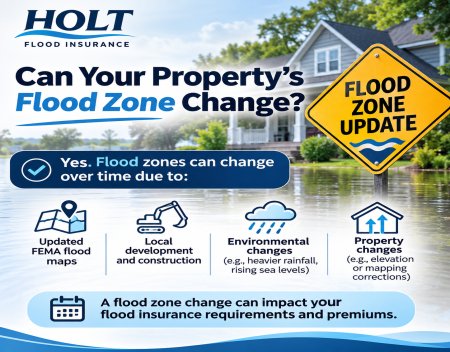
Can Your Propertys Flood Zone Change?
If you own a home or are considering purchasing property in a flood-prone area, understanding your property's flood zone is essential. Flood zones help determine your property's flood risk and can influence your flood insurance requirements and premiums.
But can your property's flood zone change over time? The answer is yes. Flood zone designations are not necessarily permanent, and several factors can cause your property to be reclassified.
The Federal Emergency Management Agency (FEMA) creates and maintains Flood Insurance Rate Maps (FIRMs), which identify areas with varying levels of flood risk.
These maps consider several factors, including:
Elevation: How high your property sits relative to potential floodwaters.
Proximity to Water: Whether your property is near rivers, lakes, coastlines, or other bodies of water.
Historical Flooding: Previous flooding events and available flood records.
Topography: The surrounding landscape and how water flows through it.
Flood Protection Infrastructure: Levees, dams, drainage systems, and other structures that may affect flood risk.
FEMA periodically updates flood maps to incorporate new information, improved technology, and changing environmental conditions.
There are several reasons your property might be assigned a different flood zone.
One of the most common reasons for a flood zone change is a FEMA map update.
As new flood studies become available, FEMA may revise flood zone boundaries to better reflect current conditions. A property previously classified as moderate or low risk could be reclassified as high risk, or vice versa.
Construction and development can influence how water moves through an area.
New roads, buildings, drainage systems, and other infrastructure may alter flood patterns. In some cases, these changes can increase or decrease the flood risk associated with nearby properties.
Coastal erosion, changing rainfall patterns, rising sea levels, and other environmental factors can affect flooding risks.
As these conditions evolve, updated flood studies may result in changes to flood zone designations.
Sometimes, a property's flood zone designation may not accurately reflect its elevation.
If a property owner provides appropriate elevation documentation, FEMA may determine that the property or structure qualifies for removal from a designated Special Flood Hazard Area.
This process may involve requesting a Letter of Map Amendment (LOMA) or another applicable FEMA map change.
The easiest way to check your property's flood zone is through the official FEMA Flood Map Service Center.
Visit msc.fema.gov and enter your property address to view available flood maps and related information.
You can also contact your local floodplain administrator to learn about proposed map revisions or recent changes in your community.
It's a good idea to check periodically, particularly if your area has experienced significant development or new flood mapping studies.
A flood zone change can have important financial consequences.
If your property is newly designated as being within a high-risk flood zone, your mortgage lender may require you to purchase flood insurance if your loan is federally regulated or backed.
Conversely, if your property is removed from a high-risk flood zone, your lender may no longer be required to mandate flood insurance, although it may still require coverage.
Your flood insurance premium may also change, but not necessarily in direct proportion to your flood zone designation. Under FEMA's Risk Rating 2.0 methodology, National Flood Insurance Program (NFIP) premiums consider property-specific flood risk factors beyond the flood zone alone.
Private flood insurance providers may use their own risk assessments and pricing methods.
Yes. If you believe your property has been incorrectly classified, you may be able to request a map change through FEMA.
Depending on your circumstances, you might qualify for a Letter of Map Amendment (LOMA) or a Letter of Map Revision (LOMR).
Supporting documentation, such as an elevation survey, may be necessary.
However, receiving an approved map amendment does not mean your property is completely free from flooding risk.
Even if your property is moved into a lower-risk flood zone, maintaining flood insurance can still be a smart decision.
Flooding can occur outside designated high-risk areas, and standard homeowners insurance policies generally do not cover flood damage.
Keeping appropriate flood insurance coverage can help protect your home and finances against unexpected flooding events.
Your property's flood zone can change, and those changes may affect your insurance requirements and coverage options.
At Holt Flood Insurance, we help property owners explore flood insurance solutions that fit their needs and budgets.
Whether your property has recently been reclassified or you're simply looking for affordable flood insurance, our team can help you compare available options.
Visit HoltFloodInsurance.com today to learn more about your flood insurance options and request a quote.
I have no problem giving you an A1 reference for taking care of the flood policies for me and Diane. I appreciate you working with the mortgage company: the surveyor and our previous agent. The result was a 75% reduction in our flood insurance premiums!
We contacted Mr. Holt for an estimate via email over the weekend prior to a closing on a property, hoping for a response on the following Monday to take with us with confidence in being insured at the settlement table on a Tuesday. He exceeded our expectations not once but in readily responding to the initial request and then to follow-up questions all during the weekend frenzy that occurs before closing. "Impressive and responsive customer service," for sure!
I have known Tim for many years and he is a man with great integrity, work ethic and one of the nicest persons I know. Over the years Tim has provided insurance counseling and advice to our company, for myself personally, as well as to our clients. Recently Tim, took time to analyze our flood insurance policy and he was able to make some excellent recommendations. Our flood insurance costs are now less and we have much better coverage. I recommend Tim to anyone without hesitation or reservation.
We'll help you:
Lower your current flood insurance premiums
Eliminate excessive & unnecessary coverage
Remove the FEMA from the claims handling process